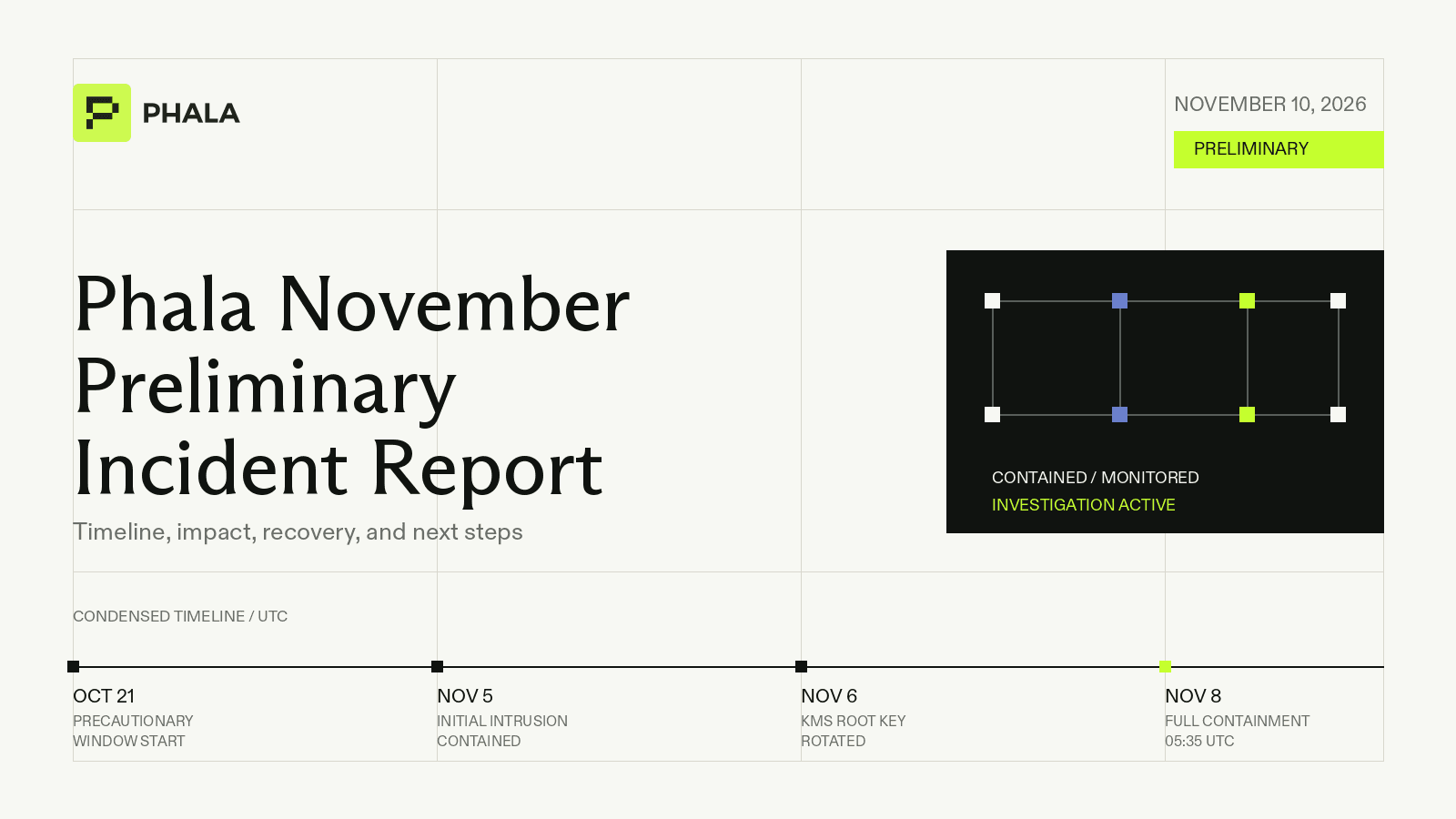
Last updated: November 23, 2026. All times are UTC. This final report supersedes the November 10 preliminary report.
Summary
From October 21 to November 1, an attacker could read requests sent to Phala's DeepSeek V4 Flash 0731 backend on OpenRouter. On November 5, the same attacker obtained the root key of Phala Cloud's legacy key management service (KMS). The attacker came in through our host management software, and our key-release policy trusted callers it should not have. The TEE hardware itself ran as designed. We closed both paths by November 6. The affected services now run on rebuilt infrastructure with a new KMS, which generated a new root key inside its TEEs.
| Who | Status | What to do |
OpenRouter users whose DeepSeek V4 Flash 0731 requests Phala served from Oct 21, 02:25 to Nov 1, 02:03 UTC | Affected | Rotate any secret you sent in those requests. |
| All other Phala traffic on OpenRouter, and Phala's direct inference customers | Not affected | None. |
Phala Cloud apps deployed before Nov 6, 05:02 UTC that derive keys with getKey() | Affected | Move anything protected by the old keys to new keys now (guide). |
| Other Phala Cloud apps deployed before Nov 6, 05:02 UTC | Migrated by us | None. You get an email when it is done. |
| Apps deployed after Nov 6, 05:02 UTC, or on the on-chain KMS | Not affected | None. |
Five failures made the attacks possible. Each now has a fix:
- An experimental server served OpenRouter traffic without production controls. Our gateway now forwards requests only to verified production TEE backends.
- Host management interfaces trusted any request from the local machine. They now require credentials, and CVMs cannot reach them.
- Phala Cloud's KMS policy checked too little before releasing keys. It now checks every caller's full identity, and a new KMS with a new root key has replaced the old one.
- We had deferred known security fixes to avoid downtime. Security fixes now take priority.
- We did not detect either attack ourselves. All platform logs now go to a central store with automated analysis. We are adding a detection rule for every step of these attacks.
Details are in Why it happened and what we changed. Questions: [email protected].
Detailed guidance
If you sent requests to DeepSeek V4 Flash 0731 through OpenRouter
If OpenRouter sent your request to Phala's DeepSeek V4 Flash 0731 deployment between October 21, 02:25 and November 1, 02:03, rotate every credential you included in those requests. This covers API keys, access tokens, passwords, private keys and .env contents. Do it even if you have seen no misuse.
This window is narrower than the one in our preliminary report; see Corrections. OpenRouter has notified affected users. If you are unsure whether Phala served your request, ask OpenRouter support with the request ID and time.
If you run applications on Phala Cloud that were deployed before November 6, 05:02
The attacker holds a copy of the old PHALA root key. They can derive anything derived from it, indefinitely. Migration does not revoke that copy. It moves your workload onto keys the attacker does not have.
| Your situation | What to do |
Your application derives keys through the dstack socket (getKey()), for wallets, signing, authorization or encrypting data | Act now. After migration, getKey() returns new keys, while the attacker can still derive the old ones. Move everything the old keys protect (assets, permissions, encrypted data) to the new keys. Your application can retrieve its old key explicitly through a new KMS API to do this. Update anything outside the CVM that trusts the old key. Redeploying or restarting the CVM does not revoke it. See the migration guide. |
| Your application only uses encrypted ENV and disks, with no socket use | No action needed. Phala re-encrypts your ENV and disks under the new root key and deletes the old ciphertext. The attacker could read encrypted environments only on the two hosts it controlled; for every other CVM it never had the ciphertext. We contacted the owners of the exposed CVMs on those two hosts directly. |
| You use the on-chain (ETH/Base) KMS | Not affected. Your root key is separate. No migration is needed. |
We contacted every affected team directly. Each team receives a confirmation email when its workloads no longer depend on the old root key.
On Phala Cloud's KMS, Phala sets the key-release policy on your behalf. If you need a policy that Phala cannot change, use the on-chain KMS, where your own smart contract sets it.
If you self-host dstack
Upgrade, then run the configuration checks in dstack guidance. An upgrade alone does not secure a deployment.
For migration help or incident-related losses, contact [email protected]. For dstack questions, open an issue on GitHub.
What happened
There were two attacks by the same attacker. The first read inference requests on one server. The second obtained the root key of Phala Cloud's legacy KMS. The full timeline is in the appendix, and technical terms are explained in the glossary.
October: requests read on the DeepSeek server
The setup. On October 20 we started an experimental DeepSeek V4 Flash 0731 deployment on GPU3, a new GPU server. It received live OpenRouter traffic before it had our production controls. Our gateway treated it as a plain OpenAI-compatible endpoint, so it never checked the server's attestation. The CVM ran in real TEE mode, but on the development OS image, which includes SSH; we kept SSH so engineers could tune the inference engine. The server's VMM was a local deployment whose deployment policy was a wildcard: it accepted any configuration change. The experiment also ran its own Grafana monitoring CVM, which kept its default administrator password.
Getting in. At 20:15 on October 20, the attacker logged into Grafana with that password. Grafana's customized monitoring script could send requests to any address the CVM could reach. CVMs on GPU3 used SLIRP networking, where 10.0.2.2 leads to the host's own loopback interface. The VMM listening there accepted any request from loopback without credentials. At 02:12 on October 21, the attacker reached it.
Taking over the DeepSeek CVM. The VMM cannot run commands inside a CVM, but it controls each CVM's prelaunch script, which runs as root in the guest before the application starts. Because the deployment policy accepted any change, the attacker replaced the DeepSeek CVM's prelaunch script and restarted it. We recovered that script: it writes the attacker's SSH public key into the guest's /root/.ssh/authorized_keys. By 02:34 the CVM was fully compromised. The attacker almost certainly logged in as root.
Hiding. At 04:55 the attacker restored the original configuration and deleted the extra CVM it had used as a foothold. A rootkit container kept running. Our best explanation is that the prelaunch script started it with docker run --restart=always, outside the Compose project. Compose's orphan cleanup removes only containers with its own project label, so it never saw this one, and the persistent disk kept it across reboots.
What the attacker got. The rootkit read request bodies. The first leaked canary key was in a request at 03:27 on October 21. The researcher's leaks stop on October 22, but nothing shows the rootkit stopped then, so the exposure window runs until November 1. The deployment's environment held one per-deployment authentication key, which we rotated.
How it ended. The experiment ended on November 1 at 02:03, and we removed the deployment. That ended the exposure. 152,092 requests reached it during the window, 0.45% of all requests our inference service handled in that time. We reprovisioned GPU3 and deployed a clean replacement. We had not yet detected the attack. On November 8 an independent researcher showed us that canary credentials sent in October had leaked and been misused. We pulled the replacement route as a precaution, with no outage for OpenRouter users. We then rebuilt the gateway and GPU backends on the new KMS, carrying over no legacy keys or disks.
November: the Phala Cloud root key obtained
Two ways in. On November 4 and 5, the attacker reached the VMM on two Phala Cloud hosts, GPU1 and GPU2, by two different routes:
- On GPU1, a legacy dstack gateway ran as a host process. In that mode its
UpdateStatecall accepted route changes from anyone. The attacker pointed public hostnames at the host's loopback, turning the gateway into a relay from the internet to the VMM. - On GPU2, a forwarding service inside a tenant CVM let the attacker send requests over SLIRP to the host's loopback VMM.
Both hosts had been excluded from host guard, the control that blocks guest-to-host traffic. Both paths ended at a VMM that required no credentials. From there the attacker created its own CVMs.
Getting keys into its own code. Application code is public by design, so anyone can check what an app runs. The attacker downloaded the code of 65 applications from Phala Cloud, but code alone gives no access to an application's keys. The host can see each CVM's encrypted environment. That is safe as long as decryption keys go only to verified code. With control of GPU1's VMM, the attacker could read the encrypted environment of every CVM on the host. Besides the root key (below), it got keys into its own code in two ways:
- It launched a CVM running its own code under the Cloud gateway's app-id. Before releasing an app's key, Phala Cloud checks that the app's code is on its approved list, but it skipped this check for the gateway. The attacker's code received the gateway key and decrypted the gateway's environment, which held its admin token, launch token and a Cloudflare API token.
- It obtained one application's key from the KMS of an older dstack stack still running on GPU1. That KMS ran in development mode, which approves every key request. Our working hypothesis is that the attacker launched an unauthorized CVM under that application's ID and used the released key to decrypt the application's environment.
All affected keys and tokens were replaced or rotated (appendix).
The root key. The KMS hands its root key to a new KMS replica only if Phala Cloud's policy approves the replica. Our policy was incomplete: we had left its allowlist check off on the legacy contract. So it only confirmed that the caller ran a known OS image. It did not check the caller's compose hash, measurement or device identity. The on-chain KMS policy checks every field. The KMS replica on GPU1 handed the root key to callers that passed this policy seven times on November 5. The first, at 09:10, reached it from the internet at the attacker's address. The other six, between 14:41 and 14:55, came from inside GPU1. The policy for ordinary application keys did check the compose hash, and refused the attacker's copy of a tenant application 19 times. A review of every legacy KMS node's logs found no other handovers. GPU3 never requested keys from this KMS, so the October attack did not reach it. Because 19 KMS replicas shared the root key, every application key derived from it had to be treated as exposed.
Containment. A customer report alerted us at 15:56 on November 4. Since then, we have been working with the customer to recover their service and find the cause of the problem. From 16:30 on November 5, once we saw the attacker was going after our hosts and keys, we stopped the attacker's CVMs, enforced host guard on both hosts, and blocked the attacker's addresses. By 17:55 we had shut down the older dstack stack on GPU1, including its gateway, VMM and KMS. That KMS released its last key at 17:37, before the shutdown. Five customer CVMs on the older stack lost public ingress until we restored them. We found no compromise of the host operating systems: no unknown logins, no persistence, no changed account files. On November 6 at 05:02 we deployed a new KMS on three dedicated nodes. It generated a new root key inside its TEEs, so no person holds it. The legacy KMS replicas, which held the old root key, kept serving existing workloads. From 23:29 on November 6 they rejected unauthorized root-key requests. We notified affected tenants and OpenRouter directly as each exposure was confirmed. Because the attacker was still active, we held back public detail until containment was complete, and published the preliminary report on November 10.
Moving off the old root key. The attacker keeps its copy of the old root key, so we moved customer data onto keys it does not have. Using key epochs (dstack PR #1574), we re-encrypt each affected CVM's ENV and disks under the new root key without recreating it, and delete the old ciphertext. As of November 21, 02:17, 2,179 of 2,271 affected CVMs had moved. The new KMS keeps the old root key as "epoch 0", so an application can explicitly fetch its old key to move what that key protects. It is never returned by default. Three legacy KMS nodes stay online for investigation with key handover disabled, and will be shut down by November 30. What matters is what still depends on the old root key, not which servers hold it, because the attacker's copy cannot be taken back.
One attacker
The GPU3 prelaunch script wrote the same SSH key, fingerprint SHA256:mv3U4QYpcwhOUm+s2TBhtxecUdtmm0jFiOiq8A8jDUQ, that was baked into a container image on GPU1/GPU2. That key and the shared method (SLIRP to an unauthenticated VMM, purpose-built CVMs, restore-and-hide cleanup) are why we attribute both attacks to one actor. The key belonged to a third party, not to Phala. The attacker has kept scanning our public-facing hosts. A review of every one found no further compromise.
Why it happened and what we changed
Five failures made these attacks possible. For each, the table shows what we changed and how it is verified:
| What failed | What we changed | Since | Verified |
| An experimental server served production traffic without production controls. GPU3 was added as a plain endpoint, so its attestation was never checked. It ran the development image with SSH. Its VMM's deployment policy was a wildcard, so the attacker's change was accepted, nothing recorded it, and the rootkit survived on the persistent disk. | The gateway's configuration allows only TEE endpoints on the OpenRouter path. Its attestation check is always on (aci_verified = true): a backend must match the reference KMS identity, the production OS image and an allowlisted app-id, or it gets no traffic. Production deployments record their policy in Phala Cloud or on chain, where verifiers can see it, and the KMS releases keys only to configurations that policy allows. GPU backends use ephemeral data disks with a fresh key on every boot. Every production deployment needs one person to initiate and another to approve. Experiments run in a test environment with no production traffic. | Nov 12–18 | Gateway policy is in the open-source private-ai-gateway; attestation is publicly verifiable; ephemeral disks are live |
| Host management interfaces trusted network location. The VMM accepted any request from loopback. SLIRP, a tenant forwarding service and the legacy gateway each made loopback reachable. Host guard was missing on GPU3 and excluded on GPU1/GPU2. A default password opened the first door. | The VMM listens only on a local Unix socket. Every call goes through nginx, which requires an API key and an allowed source address. Host guard runs on every host, with bridged networking and host firewalling. The legacy gateway is shut down. A guessed password on a monitoring service no longer reaches the host or OpenRouter traffic. | Nov 5–19 | Verified on the gateway and GPU hosts serving OpenRouter |
| Phala Cloud's KMS policy checked too little. Replica onboarding checked only that the OS image was known, not the compose hash, measurement or device identity. Phala Cloud skipped the code check for the gateway's app-id. An older dstack KMS on GPU1 ran in development mode and approved every key request. | A new KMS with a new root key runs on dedicated nodes with no customer CVMs. Its policy admits a replica only with a matching compose hash, measurement and device identity. Unsigned authorization requests are refused, and replica handover is off outside migrations. The gateway's key goes only to approved gateway code on an approved host, and the gateway will not start without a launch token held by operators. Neither different code nor an exact copy can obtain it. The older dstack stack is shut down. | Nov 6–10 | Registered replica admitted and unregistered caller rejected, Nov 19; gateway ID with modified code refused, Nov 6 |
| We had deferred known security fixes. GPU1 was the last node still running the legacy dstack gateway, which our other nodes had already replaced. GPU1 and GPU2 had been excluded from host guard. We had put both off to avoid downtime for the workloads on those nodes. | Security fixes take priority over availability. We patch to published deadlines and schedule maintenance windows instead of deferring. | Nov 2026 | Published vulnerability management policy |
| We did not detect either attack ourselves. The prelaunch change, the configuration reverted 2.5 hours later and the bursts of compose downloads were all visible, but nothing alerted on them. Most teams on the old root key learned of its compromise later than the directly affected tenants. | All platform logs stream to a central log store, where automated analysis runs 24/7. Each signal we missed is now a detection rule. We now notify affected partners, including OpenRouter, as soon as we have credible evidence of exposure, before the investigation finishes. | Analysis live; rules being added | Each rule is tested against a simulated attack step |
Would the October attack work today?
No. It needed every step to succeed, and each step is now blocked on its own:
- GPU3 could not receive OpenRouter traffic. The gateway would refuse it: it was not an attested production TEE backend.
- The attacker could not reach the VMM. Host guard blocks the path from Grafana's CVM to the host, and the VMM now requires credentials.
- A changed prelaunch script would not run. On a production deployment, the KMS releases keys only to the configuration recorded in its policy. A CVM with a changed script gets no keys, so it cannot open its disk or start serving.
- Anything planted would not survive a restart. GPU backends now use ephemeral disks.
Would the November attack work today?
No. Each of its steps is now blocked:
- The attacker could not reach the VMM. The legacy gateway is gone, host guard blocks guest-to-host traffic, and the VMM requires credentials.
- A CVM it launched would not get the root key. The new KMS hands its root key only to replicas whose compose hash, measurement and device identity are on the allowlist. Handover is off outside migrations.
- Claiming another app's ID would not get that app's key. Phala Cloud checks every app's code, including the gateway's. The gateway also needs an approved host and an operator-held launch token.
- The old root key protects almost nothing. 96% of affected CVMs have moved off it, and the rest move by November 30.
Operating principles
These principles came out of our post-mortem. They apply to every system we run, not only the ones that were attacked.
- Everything we deploy for customers is production-ready. Every production deployment needs two people: one initiates it and another approves it. dstack 0.6 removes the separate development image. SSH access must instead be declared in the Docker Compose file, so it is part of the measured configuration that anyone checking attestation can see. Development setups stay available for non-production use.
- Zero trust. Network location is never authentication, on any system we run.
- Security fixes come first. We patch to the published deadlines (critical in 7 days, actively exploited: triage in 24 hours, mitigation in 72) and schedule maintenance windows instead of deferring.
- Extra care on critical components. The gateway, the KMS, the VMM and our CI/CD pipeline can each become a single point of failure. Every change to them goes through required code review, and they are first in scope for every audit and penetration test.
- Find vulnerabilities before attackers do. We have run AI security scans on our code for several quarters. They did not find what the attacker found. We are moving to continuous penetration testing of production, and will patch findings before they can be used.
- Continuous intrusion detection. Automated analysis watches our central logs 24/7. We are extending it to every core system, to shorten the time between an intrusion and our response.
- Canaries of our own. A researcher's canary credentials exposed the October breach. We will run our own: canary requests through OpenRouter and canary credentials in our systems, with alerts on any use.
- Defense in depth beyond attestation. As a last line of defense, production launches also need an allowlisted device and a launch token held by a human operator. This is in place for gateways and KMS nodes, and we are extending it to other production CVMs.
We have also written down our security baseline and measure ourselves against it. It covers host and image vulnerability scans with a published patching SLA, a hardening baseline, and an exception register with owners and expiry dates. Full results, including open gaps, are available to partners on request.
Corrections to the preliminary report
We wrote the November 10 report while the attacker was still active, so it used cautious estimates. The investigation has since corrected five points:
- Exposure window. The preliminary window was October 21 00:00 to November 8 05:35. The established window is October 21 02:25 to November 1 02:03: from when the attacker began modifying the DeepSeek CVM to when we removed the deployment.
- Two deployments. The compromised deployment was removed on November 1. The endpoint we pulled on November 8 was its clean replacement. We removed it as a precaution, before we knew which deployment had been hit.
- Latest observed misuse. The preliminary report said November 9. The last misuse in the researcher's dataset is on November 7 at 01:05:17.
- Number of servers. The preliminary report described one server. The attacker reached three: the DeepSeek server in October and two Phala Cloud hosts in November.
- Containment time. The preliminary report labelled "Nov 5 08:15–17:55" as containment. 08:15 was the attacker's first success. Our containment began around 16:30.
What is still open
These items are still open, starting with the work on our AI inference service:
| Item | Owner | Target |
| External penetration test of production | Security | Started Nov 23; ETA: Nov 27 |
| Test each detection rule against a simulated version of the attack step it covers | Security | Nov 30, 2026 |
| Migrate the remaining 92 CVMs off the old root key | Platform | Nov 30, 2026 |
| Shut down the three remaining legacy KMS nodes | Platform | Nov 30, 2026 |
| Confirm that the owners of the 509 applications that derive keys through the socket have moved what the old keys protect | Customer success | Weekly follow-up until closed |
Some of the October account is reconstruction. We recovered the attacker's prelaunch script; the docker run persistence mechanism is our best explanation of how the rootkit survived. These points remain unknown: the rootkit's code and where it sent data, which addresses drove the GPU3 VMM, and how the attacker first found the Grafana CVM. None of them changes the exposure window or the guidance above.
Closing
This incident exposed requests that Phala served for one OpenRouter model to an attacker, and it compromised the root key of Phala Cloud's legacy KMS. Our users did not cause either.
The fixes change the design, not just the individual bugs. Traffic reaches only backends that prove what they run. Management interfaces authenticate every caller. Keys go only to verified code. Stateless services restart clean. The gateway's policy is open source, and its attestation is publicly verifiable.
We thank the customer who reported the November activity, the researcher whose canary testing exposed the October compromise, the third party who helped us trace the SSH key, and OpenRouter for notifying its users quickly.
For migration help or other questions, contact [email protected]. For dstack questions, open an issue on GitHub.
The Phala CERT Team
Appendix: glossary
| Term | Meaning |
| app-id | An app's identity on Phala Cloud. Its keys are derived from it. |
| Attestation | Evidence signed by the TEE hardware of exactly what a CVM is running. |
| Compose file, compose hash | An app's deployment definition (its containers and prelaunch script) and the hash of it. Attestation covers the compose hash. |
| CVM | Confidential virtual machine: a VM whose memory the TEE hardware protects from the host. |
| dstack | The open-source TEE platform Phala Cloud runs on. |
getKey() | The dstack call an app uses to derive its own keys. |
| Host guard | A firewall on each host that blocks traffic from CVMs to the host's own services. |
| Key epochs | Versions of a root key. They let data be re-encrypted under a new key without recreating the app. |
| KMS | Key management service: releases keys to CVMs that pass its policy. Three appear in this report: Phala Cloud's KMS (the legacy one, replaced on Nov 6), the on-chain KMS (policy set by the customer's own smart contract; not affected), and the KMS of an older dstack stack on GPU1 (development mode; shut down Nov 5). |
| Prelaunch script | A script in the compose file that runs as root inside the CVM before the app starts. |
| Replica handover | How a new KMS replica receives the shared root key. |
| Root key | The KMS's master key. Every app key is derived from it. |
| SLIRP | A VM networking mode in which the address 10.0.2.2 reaches the host itself. |
| TEE | Trusted execution environment: hardware such as Intel TDX and NVIDIA confidential computing that isolates a CVM from its host. |
| VMM | The host software that creates, starts and configures CVMs. |
Appendix: timeline
The timeline has three parts: the October attack on the DeepSeek server (GPU3), the November attack on two Phala Cloud hosts (GPU1 and GPU2), and our response. Gaps mean no surviving record, not that the attacker was idle.
October: GPU3
An independent researcher's canary credentials, sent in test requests, exposed this attack.
| Time (UTC) | Event |
| Oct 20, 02:23 | Experimental DeepSeek deployment starts on the new GPU3 server, on the development OS image, and receives live OpenRouter traffic through our router. |
| Oct 20, 20:15 | Attacker logs into the experiment's Grafana monitoring CVM with the default admin password and starts probing the internal network. |
| Oct 21, 02:12 | Through Grafana's customized monitoring script, attacker reaches the unauthenticated VMM at 10.0.2.2 (the host's 127.0.0.1) over QEMU user-mode networking (SLIRP). |
| Oct 21, 02:25 | Attacker begins replacing the DeepSeek CVM's prelaunch script. Exposure window starts. First request in the window: 02:25:29. |
| Oct 21, 02:34 | Modified prelaunch script has run as root in the guest. The CVM is fully compromised. |
| Oct 21, 03:27:40 | First researcher canary request whose AWS key later leaks. |
| Oct 21, 04:55 | Attacker restores the original configuration and deletes the CVM it had used as a foothold. A rootkit container keeps running. |
| Oct 22, 02:36:45 | Last canary request in the researcher's dataset. |
| Oct 22, 05:41:23 | First recorded misuse of a canary key. |
| Nov 1, 02:03 | Experiment ends. Deployment and route removed. Exposure window ends. Last request in the window: 02:00:52. We had not yet detected the intrusion. |
| Nov 1 | GPU3 reprovisioned to the production baseline. A clean replacement deployment starts serving, with a new application identity and no inherited state. |
| Nov 7, 01:05:17 | Last recorded misuse of a canary key. |
| Nov 8, 04:12 | Independent researcher's evidence reaches us. |
| Nov 8, 05:35 | Replacement route removed as a precaution. Other backends absorb the traffic; OpenRouter users see no outage. The service is then rebuilt on the new KMS. |
November: GPU1 and GPU2
In November the attacker obtained application keys and the legacy KMS root key, until we contained them on November 5:
| Time (UTC) | Event |
| Nov 4, 15:56 | First customer report reaches us. It predates our earliest record of the attacker, so the activity began before 19:33. |
| Nov 4, 19:33 | First recorded scan from 82.29.131.62. |
| Nov 5, from 00:00 | Attacker scans 1,055 app-ids. 461 unauthenticated requests to Cloud's attestations endpoint return full compose files for 65 applications. |
| Nov 5, 00:43 | GPU2: attacker starts using a forwarding service inside a tenant CVM. |
| Nov 5, 08:15:12 | GPU1: first successful unauthenticated UpdateState call on the legacy gateway. |
| Nov 5, 09:10:24 | First root-key handover, to a caller reaching the KMS from the internet at the attacker's address. |
| Nov 5, 11:03 | GPU1: attacker creates CVMs through the VMM. |
| Nov 5, 12:51 | GPU2: attacker reaches the VMM through SLIRP. Backdoor CVM created at 13:04. |
| Nov 5, 14:04–14:12 | Attacker CVMs copy their own key files and decrypted environments. |
| Nov 5, 14:34 | A CVM impersonating the Cloud gateway's application identity obtains the gateway application key. |
| Nov 5, 14:41–14:55 | Six more root-key handovers, over loopback. |
| Nov 5, 16:30 | Containment begins. Attacker CVMs stopped. Host guard enforced on GPU1/GPU2 at 16:47. Attacker addresses blocked at 17:45. Legacy gateway stopped at 17:50. Older dstack stack's VMM, KMS and gateway shut down by about 17:55. |
| Nov 5, 17:37 | A copy of a tenant's application obtains its key from an older dstack stack's KMS on GPU1. Last attacker key retrieval we found. |
Response and recovery
After containment, we deployed a new KMS with a new root key, hardened the management plane and migrated affected workloads:
| Time (UTC) | Event |
| Nov 6, 00:30 | New KMS contract created with boot allowlists. New KMS cluster brought up on three dedicated nodes. |
| Nov 6, 02:14:10 | Inventory snapshot used for every scope figure in this report. |
| Nov 6, 05:02:39 | New KMS and root key live. All new deployments use them. 24 new gateways come online. |
| Nov 6, 23:02 | Gateway compose-hash allowlist enforced. A test CVM claiming the gateway's ID with modified code is rejected (Gateway compose hash not allowed). The legitimate gateway restarts and receives its key. |
| Nov 6, 23:29 | All 19 legitimate KMS replicas registered; strict allowlist enforced on the legacy KMS contract. Later unauthorized requests are rejected. |
| Nov 7–10 | Bearer-token authentication enforced on external management endpoints. Replica key handover disabled outside migration windows. |
| Nov 8 | VMM hardened. It listens only on a local Unix socket. Every RPC goes through nginx, which requires an API key and an allowed source address. |
| Nov 10 | Preliminary report published so OpenRouter could notify its users. |
| Nov 12 | Ephemeral data disks available in dstack 0.6.3+. |
| Nov 13, 12:39:55 | dstack PR #1574 merged. Key epochs allow ENV and disk re-encryption without recreating stateful applications. |
| Nov 18 | The confidential inference gateway (private-ai-gateway) starts checking every backend's attestation against the reference KMS identity, OS image and allowlisted app-ids. Legacy KMS reduced from 19 nodes to 3, with key handover disabled. |
| Nov 19 | Handover-off state confirmed. Allowlist admission and rejection tests run. Platform migration starts. Review of all public-facing hosts (Nov 5–19) completed: no further compromised hosts found. |
| Nov 20 | Forced migration of the remaining CVMs (maintenance notice). By Nov 21, 02:17, 2,179 of 2,271 affected CVMs had migrated. The remaining 92 include CVMs blocked by technical problems and Phala's own experimental CVMs. |
| Nov 20–21 | Vulnerability scans, hardening baseline, AWS and Cloudflare assessments. |
Appendix: incident figures
These figures show who was affected and how far recovery has come:
| Figure | Value | Context |
| Requests to the affected DeepSeek deployment, Oct 21 02:25:29 – Nov 1 02:00:52 | 152,092 | 0.45% of the 33,586,461 requests our inference service handled in that window, across all models. Requests at risk, not requests proven read |
| Phala Cloud applications that relied on the old root key | 2,169 | Snapshot of Nov 6 02:14:10. On-chain KMS applications were not affected |
| Of those, applications whose owners needed to do nothing | 1,660 (77%) | Phala migrated them |
| Of those, applications whose owners must act | 509 (23%) | They derive keys with getKey() |
| Affected CVMs migrated to the new root key by Nov 21, 02:17 | 2,179 of 2,271 (96%) | The rest are blocked by technical problems or are Phala's own experiment CVMs |
| Customer-visible outages caused by our response | None on OpenRouter | Five legacy CVMs briefly lost public ingress |
Appendix: credentials
The table shows what we did with each credential involved in the incident.
| Credential | Action |
| Cloud gateway application key | Replaced |
| Gateway admin token | Rotated |
| Gateway launch token (shared by all gateways) | Rotated; all 24 gateways redeployed with it |
| Cloudflare API token | Rotated when its exposure was found |
| Affected application key on GPU1 | Replaced by its owner |
| DeepSeek per-deployment authentication key | Rotated |
| Eight researcher canary keys | Kept live deliberately, under the researcher's control, to keep observing the attacker |
Appendix: detection rules
Each rule below turns one observed attacker step into an alert:
- A compose hash or prelaunch script that changes and then returns to its previous value within hours.
- A running container without a docker-compose service definition.
- A prelaunch script or compose that writes
authorized_keysor enables SSH without declaring as a dev CVM. - Any CVM traffic to
10.0.2.2on management ports. - A
GetKmsKeyrequest from an unregistered caller. Rejections alert too, because a rejection means an attempt. - Bursts of compose-bearing attestation requests, and a known app-id appearing with an unfamiliar device or measurement.
Rules 1–5 match steps of the October attack. Rules 6 and 7 match November's. A rule counts as done only after it has fired on a test.
Appendix: dstack guidance
If you self-host dstack, upgrade to at least the minimum fixed version for your branch:
| Branch | Recommended | Minimum with fixes |
| 0.5 | 0.5.15 | 0.5.13 |
| 0.6 | 0.6.5 | 0.6.2 |
Version alone was not the cause of this incident. After upgrading, check that your deployment meets each of these conditions:
- The gateway does not accept unauthenticated
UpdateStatecalls. Do not run a 0.5.x gateway as a host process. - Every VMM management endpoint requires credentials. Loopback access is not authentication. Prefer a Unix-socket VMM behind an authenticating proxy.
- Host guard, or an equivalent control, blocks guests from reaching host services through
10.0.2.2. - Workloads handling real user data use a key provider that enforces your deployment policy (OS image and compose).
- If you run your own KMS policy, replica onboarding checks the compose hash, measurement and device identity. Replica handover stays off outside migrations.
- Stateless services use ephemeral data disks (0.6.3+).
- Stateful services that must survive a compromised host use a KMS whose release policy the host operator cannot change, such as the on-chain KMS.
Appendix: indicators
Operators can search their own systems for these signs of this attacker's activity:
| Indicator | Use |
SHA256:mv3U4QYpcwhOUm+s2TBhtxecUdtmm0jFiOiq8A8jDUQ (ED25519) | Search guest authorized_keys, prelaunch scripts and dockerfile_inline blocks. Not a Phala key. Public key: ssh-ed25519 AAAAC3NzaC1lZDI1NTE5AAAAIIhLRg7YXYcb2CpQzt32hwSJzzPI+QBQ6SKCeK7qwIth |
82.29.131.62, 159.223.110.159 | Attacker sources, November |
| Prelaunch scripts that change and then revert | Concealed modification of a CVM |
| Containers with a restart policy and no Compose project label | Persistence outside the application's lifecycle |
CVM traffic to 10.0.2.2 on 9082/9083/9980/18120 | Guest-to-host management access |
GetKmsKey from unregistered callers | Root-key handover attempts |
104.28.222.46 appears in our records but is Cloudflare infrastructure. We do not attribute it to the attacker. We do not publish customer identifiers or sensitive data. We can share more detailed indicators privately with affected parties.